Loading
CFA® Program · Level III
CFA Level III — portfolio management
Level III is the capstone — half constructed-response essay, half item sets, all about applying everything you've learned to manage real portfolios for real clients. The bar is judgement, not recall.
Free plan: no card, no time limit. 7-day full refund on a first purchase, no questions asked.
Level IIIAt a glance
- Sessions2
- FormatEssay + item sets
- Recommended study350+ hoursacross the level
- Topics8weighted by the official curriculum
Exam format and topic weights are set by CFA Institute. WSU is an independent provider and not affiliated with them.
Curriculum
§ 01What Level III actually covers.
Every topic with its published weight, so study time can be allocated against the exam rather than against intuition.
| Topic | Weight | What it covers |
|---|---|---|
| Asset Allocation | 15–20% | Strategic and dynamic asset allocation, capital-market expectations, scenario and liability-relative frameworks. |
| Portfolio Construction | 15–20% | Active management, factor investing, manager selection, ETFs and rebalancing. |
| Performance Measurement | 5–10% | Attribution analysis, benchmark selection, risk-adjusted return metrics and GIPS reporting. |
| Derivatives & Risk Management | 10–15% | Hedging currency and equity exposure, swap and option strategies, risk-budgeting. |
| Ethics & Professional Standards | 10–15% | Code & Standards plus Asset Manager Code — applied to real client situations under time pressure. |
| Pathway: Portfolio Management | Specialised | The default pathway — institutional and private wealth, behavioural finance, taxes and estate planning. |
| Pathway: Private Wealth | Specialised | Optional specialisation pathway — high-net-worth client planning, lifecycle goals, tax-aware investing. |
| Pathway: Private Markets | Specialised | Optional specialisation pathway — private equity, private debt and infrastructure across the full investment cycle. |
| 8 topics | 100% | Weights are published by CFA Institute and may be stated as ranges. |
Outcomes
§ 02What a Level III candidate should own.
The capabilities the level is testing for, stated as things you should be able to do rather than chapters you should have read.
- Construct a defensible Investment Policy Statement for both institutional and individual clients.
- Translate capital-market expectations into a strategic asset allocation that fits a client's objectives and constraints.
- Write CFA-style constructed-response answers — concise, command-word-aware, and graded by the rubric.
- Hedge currency, equity and rate exposure using derivatives and explain the trade-offs to a non-technical client.
- Run performance attribution and explain why a portfolio out- or under-performed its benchmark.
- Apply the Code & Standards plus the Asset Manager Code to nuanced, on-the-job ethics scenarios.
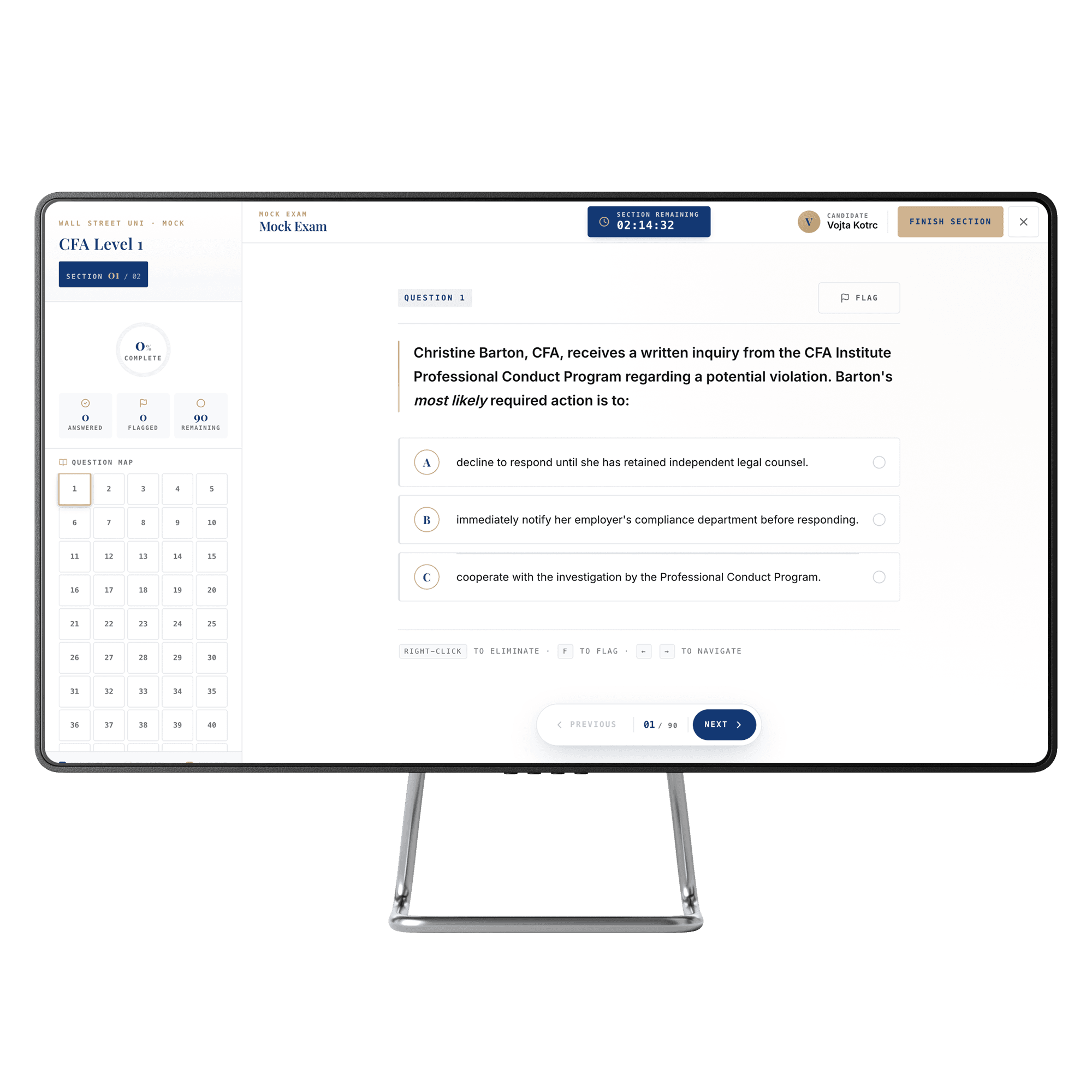
The sitting
§ 03The shape of the exam.
How the paper is structured and how long you have: the constraints worth rehearsing under before exam day.
QuestionsEssays + item sets
Duration4h 24m total
Sessions2 × 2h 12m
Recommended study350+ hours
Recent Level III pass rates have hovered around 50–55% — the highest of the three exams. The catch: the essay session demands written precision the earlier levels never tested.
On WSU
§ 04The module set, tuned for Level III.
What the platform provides against this level specifically.
- Essay-writing drillsPractice the constructed-response format with command-word prompts, rubric-aligned model answers, and time-pressured drills.
- Portfolio-management analyticsTrack mastery across asset allocation, portfolio construction and performance measurement — the topics that decide the pass.
- WSU AI tutor for essaysPaste your essay answer and get rubric-style feedback — what the grader will reward, what they will dock, and exactly how to tighten the response.
- Full-length Level III mocksRealistic two-session simulations covering both the essay and item-set formats — calibrate stamina and timing before exam day.
Compare the three levels on the programme overview, or see every capability on the features page.
Ready to prepare for Level III?
Pick your sitting on the next page — every Level III tier includes essay drills, full mocks, and the AI tutor.
Wall Street Uni is an independent study platform and is not affiliated with, endorsed by, or sponsored by CFA Institute.